The digital landscape has undergone a tectonic shift. A decade ago, a business could “win” by simply having a functional website and running a few Google Ads. Today, the bar has been raised to an almost impossible height. Between AI-driven search algorithms, strict data privacy laws, and the hyper-fragmentation of social media, the “DIY” or “single-hire” approach to marketing isn’t just difficult—it’s a financial risk.
If you are weighing the decision to keep your marketing in-house or outsource it to a dedicated firm, you aren’t just choosing a service; you are choosing a growth philosophy. This guide breaks down why hiring a digital marketing agency is no longer an “extra” expense, but a fundamental requirement for companies that intend to lead their industries.
The Market Has Already Made the Decision
This shift isn’t theoretical—it’s measurable. The global digital advertising and marketing market is projected to reach $786.2 billion by 2026, reflecting an explosion in complexity, competition, and spend. Search advertising alone accounts for $202.4 billion, making it the single largest battleground for customer acquisition.
Unsurprisingly, businesses are responding by outsourcing expertise. In 2025, 63.1% of brands relied on digital marketing agencies, up sharply from 46.2% just a year earlier. This isn’t a trend—it’s a survival response to a market that now rewards specialization over generalization.
The Myth of the “Marketing Unicorn”
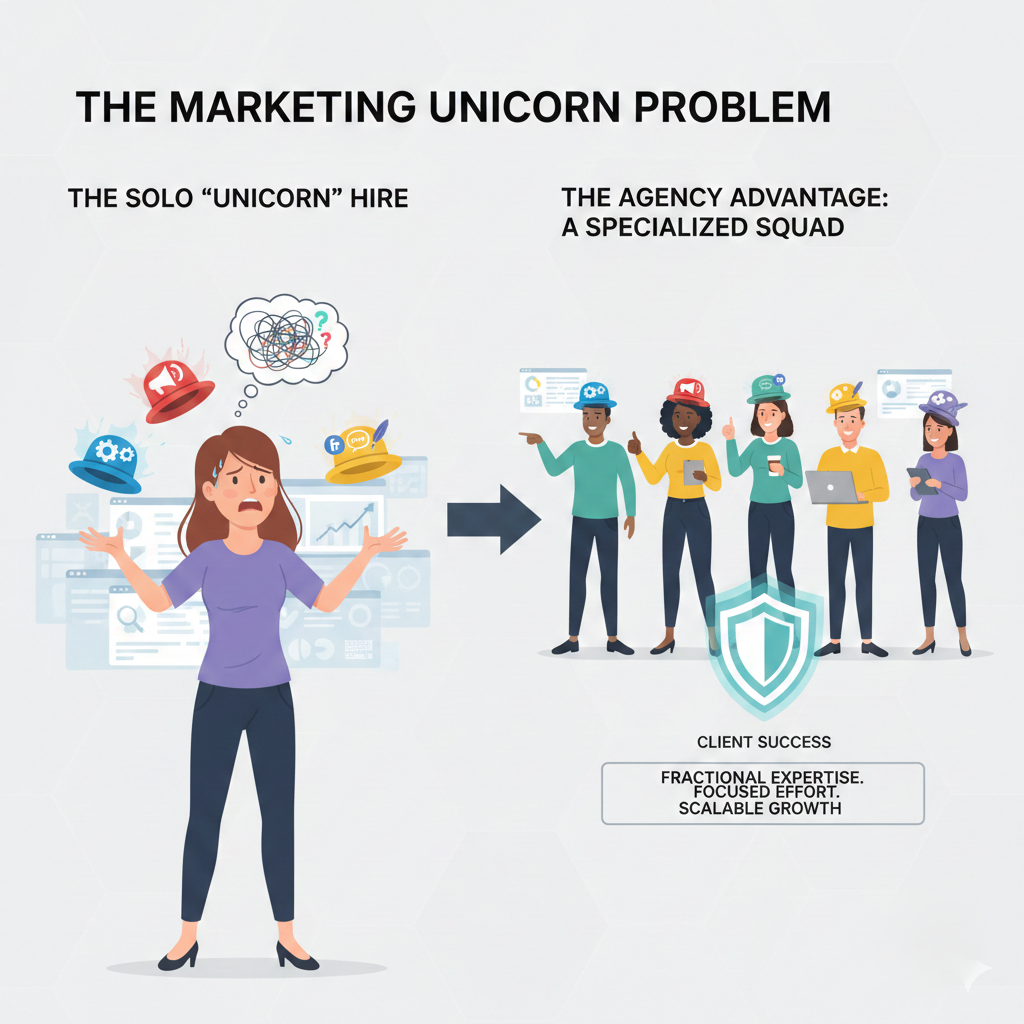
One of the most common mistakes founders and CEOs make is trying to hire a “Marketing Manager” who can do it all. They look for someone who can write compelling copy, manage $50,000 in monthly ad spend, design high-converting landing pages, handle technical SEO, and manage the brand’s TikTok presence.
Here is the reality: that person does not exist.
In the marketing world, we call this the “Unicorn Problem.” When you hire an individual, you are limited to their specific skill set and the 40 hours they have in a week. If they are great at creative writing, your data analytics will likely suffer. If they are a math-driven media buyer, your brand voice will likely feel robotic.
The Agency Advantage: A Specialized Squad
When you hire an agency, you aren’t hiring one person. You are hiring a collective. Your account usually touches:
- A Content Strategist who ensures your voice is consistent.
- A Media Buyer who lives and breathes Facebook and Google algorithm updates.
- An SEO Specialist who monitors your site’s technical health.
- A Creative Director who ensures your visual assets stop the scroll.
You get the “fractional” time of five experts for the price of one mid-level salary. This diversity of thought prevents the tunnel vision that often plagues internal teams.
The payoff for this specialization is performance. Agency-managed SEO campaigns deliver some of the highest returns in marketing—748% ROI for B2B companies and 721% for B2C, outperforming nearly every other channel over time. While SEO requires a 4–6 month ramp-up, the compounding gains consistently eclipse short-term tactics.
Across paid media, content, email, and SEO, agencies routinely achieve 3:1 to 5:1 ROI, not because of any single tactic, but because integrated strategies outperform isolated efforts run in silos.
The “Hidden” Economics of Agency Partnerships
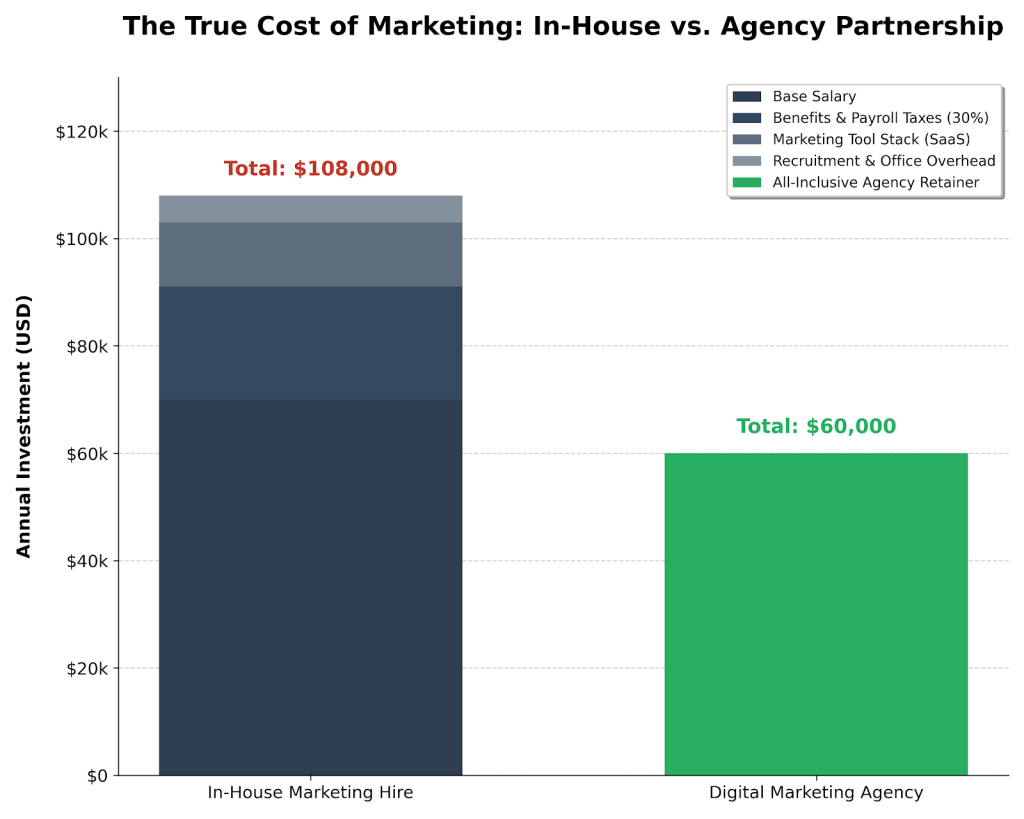
Most decision-makers look at an agency’s monthly retainer and compare it directly to a salary. This is an “apples-to-oranges” comparison that ignores the massive overhead associated with internal departments.
The Tool Stack Tax
To run a modern marketing department, you need software. High-level tools for SEO (Ahrefs/SEMrush), heat-mapping (Hotjar), social scheduling (Sprout Social), and CRM automation (HubSpot) can easily cost a company $3,000 to $5,000 per month just in licensing fees. Agencies absorb these costs. They have enterprise-level accounts that they leverage across their client base, giving you the benefit of “Big Data” tools without the monthly subscription headache.
Payroll and Productivity
A $70,000 salary for an in-house hire actually costs a company closer to $90,000 after you factor in:
- Payroll taxes and insurance.
- Health benefits and 401k matching.
- Onboarding and training time (which usually takes 3-6 months to see ROI).
- Office space and hardware.
An agency is a “plug-and-play” solution. There is no ramp-up period, no “culture fit” training, and no liability if they underperform. If an agency doesn’t deliver, you end the contract. If an employee doesn’t deliver, you face a much more complex (and expensive) HR situation.
The Power of “Cross-Pollinated” Data
One of the most underrated benefits of an agency is that they don’t work in a vacuum. They are currently managing dozens of other accounts, often in industries adjacent to yours.
Why does this matter? Because agencies see trends before they become news.
If a new Google Core Update rolls out on a Tuesday, an agency will notice a pattern across 20 different websites by Wednesday morning. They can pivot your strategy immediately based on what they see working elsewhere. An in-house team, however, only sees your data. They might spend three weeks wondering why traffic is dropping before they realize it’s a global algorithm shift.
This “crowdsourced intelligence” allows your business to stay ahead of the curve, benefiting from the wins—and the mistakes—of a much broader data set.
Agility: Scalability on Demand
Business isn’t a straight line; it’s a series of peaks and valleys.
Imagine you are a retail brand approaching Black Friday. Your workload for November is 10x higher than it is in February. If you are in-house, your team is likely burnt out and under-resourced during the peak, or bored and overpaid during the valley.
An agency provides elasticity. When you need to scale up—perhaps for a product launch or a seasonal push—the agency can dedicate more resources, more designers, and more ad managers to your account. When things quiet down, you aren’t stuck paying for idle hands. This agility allows you to be aggressive when the market is hot and lean when it’s not.
The Outside-In Perspective: Breaking “Brand Blindness”
When you live inside a business every day, you develop “Brand Blindness.” You know your product so well that you lose the ability to see it through the eyes of a new customer. You use industry jargon that confuses people, and you overlook friction points in your sales funnel because “that’s just how we’ve always done it.”
An agency brings a cold, objective eye to your business. They ask the “stupid” questions that your customers are asking. They look at your website and say, “This checkout process is confusing,” or “Your value proposition isn’t clear in the first five seconds.”
This objective audit is often where the biggest “wins” are found. It’s not always about spending more on ads; often, it’s about fixing the leaky bucket that the in-house team was too close to see.
Access to Platform Insiders
In the world of digital marketing, who you know matters. Large agencies often hold “Preferred Partner” status with platforms like Google, Meta, and TikTok.
This isn’t just a fancy badge for their website. It means they have:
- Dedicated Account Representatives: If your ad account gets flagged or banned by a bot (which happens more than you’d think), an agency can often get a human on the phone in minutes to fix it. An in-house team might be stuck in the “support ticket” void for weeks.
- Beta Access: Agencies get invited to test new ad formats and targeting tools before they are released to the general public. This gives you a “First Mover Advantage,” allowing you to reach customers in ways your competitors can’t yet.
In-House vs. Agency vs. Freelancer: The Brutal Comparison
To help you visualize the choice, let’s look at how these three options stack up across the four pillars of marketing success.
| Feature | In-House Hire | Freelancer | Digital Agency |
| Breadth of Skill | Narrow (One person) | Specialized (One niche) | Broad (Multi-disciplinary) |
| Reliability | High (until they quit) | Variable (often a “side-gig”) | High (Contractual obligation) |
| Tools & Tech | Expensive for you | Limited | Included in retainer |
| Scalability | Hard (must hire more) | Limited by their hours | Seamless |
| Strategic Input | Often biased | Executional only | High-level consulting |
Identifying the “Snake Oil”: How to Hire Right
The benefits listed above only apply if you hire a good agency. Unfortunately, the low barrier to entry in the marketing world means there are plenty of “experts” who are just learning on your dime.
The Red Flags
- The “Guaranteed #1” Ranking: No one owns Google’s algorithm. If they promise a specific rank, they are either lying or using “Black Hat” techniques that will eventually get your site penalized.
- Lack of Transparency: If they won’t let you see your own ad accounts or if they send reports that only show “impressions” and “clicks,” they are hiding something. You need to see ROAS (Return on Ad Spend) and CPA (Cost Per Acquisition).
- The “Yes Men”: A good agency will tell you when your idea is bad. If they agree with everything you say, they aren’t partners; they’re order-takers. You pay an agency for their expertise, not their compliance.
The “Must-Ask” Questions
Before signing a contract, ask these three questions:
- “Who is actually doing the work?” (Ensure your account isn’t being offshored to a low-cost subcontractor without your knowledge.)
- “How do you handle a campaign that is failing?” (Their answer will reveal their analytical process and their honesty.)
- “Can I see a case study from a client with a similar budget/goal?” (Not just a big brand name, but someone in your shoes.)
Conclusion: The Verdict on Your Growth
The decision to hire a digital marketing agency shouldn’t be based on a desire to “offload” work. It should be a strategic move to upgrade your capabilities.
By partnering with an agency, you are buying more than just SEO or Facebook Ads. You are buying:
- Time: To focus on your product and your customers.
- Certainty: That your budget is being managed by specialists, not generalists.
- Speed: The ability to pivot as fast as the market moves.
In 2026 and beyond, the gap between companies that leverage expert agency partnerships and those that try to do it all themselves is only going to widen. The question isn’t whether you can afford an agency—it’s whether you can afford to stay stagnant while your competitors are utilizing a full team of experts.