Most agency founders start with a “hero” mentality. They land the clients, execute the strategy, and put out the fires. But as the roster grows, the hero begins to burn out. The quality of work dips, client churn spikes, and the agency hits an invisible ceiling.
The difference between a struggling boutique and a high-growth firm isn’t the quality of their creative—it’s the strength of their digital marketing agency operations.
Operations are the invisible engine of your agency. If that engine is poorly maintained, you can’t go faster without breaking the car. This guide will walk you through the frameworks, tech stacks, and SOPs required to build a scalable, profitable agency operation.
What Are Digital Marketing Agency Operations?
At its simplest, digital marketing agency operations represent the bridge between the promise made by sales and the results delivered to the client. It is the art of managing people, processes, and platforms to ensure work is completed on time, within budget, and at a high standard.
The Bridge Between Sales and Delivery
Without operational oversight, sales and delivery exist on two different islands. Sales might promise a 30-day turnaround on a complex SEO audit, while the delivery team is already at 110% capacity. Operations ensure these two departments speak the same language.
Hero-Based vs. Process-Based Agencies
- The Hero-Based Agency: Relies on the individual brilliance of a few key players. If your Head of Paid Media gets sick, the agency grinds to a halt.
- The Process-Based Agency: Relies on systems. Work is governed by agency SOPs (Standard Operating Procedures), meaning anyone with the right skill set can step in and execute the workflow to the same standard.
The 4 Core Pillars of Digital Marketing Agency Operations
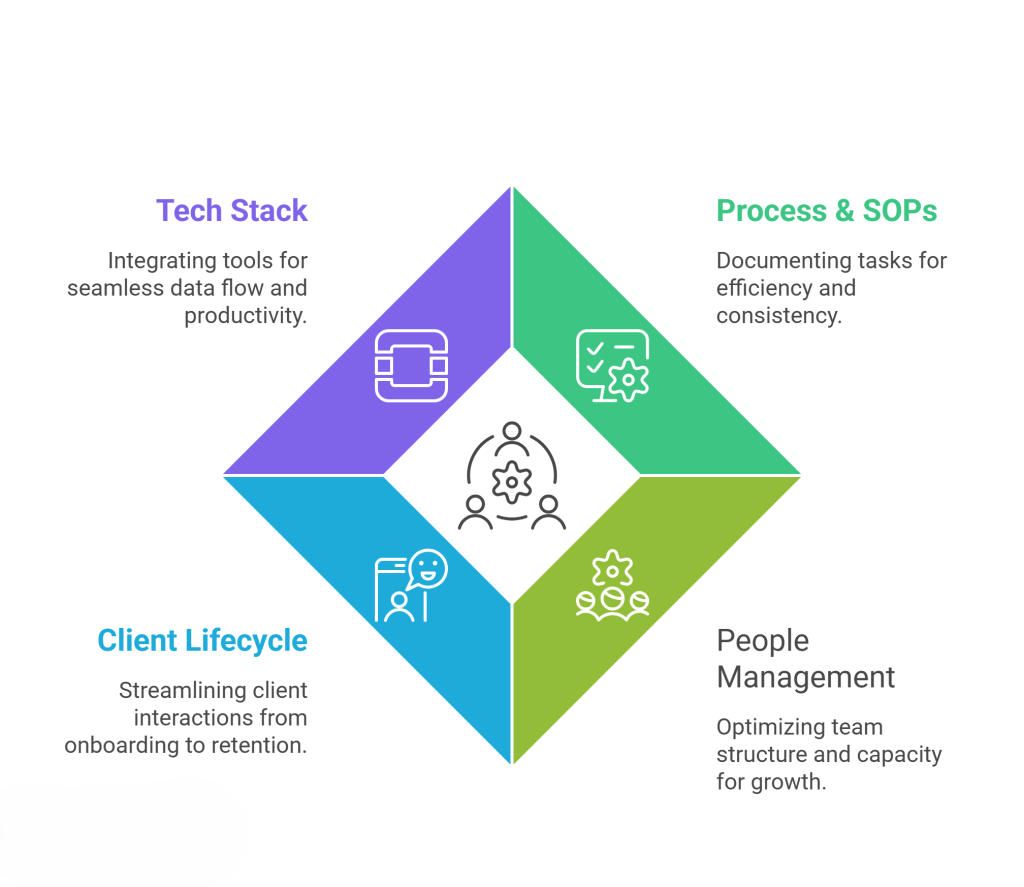
To scale effectively, you must treat your agency as a product. Every product needs a blueprint. These four pillars form that blueprint.
1. Process & Standard Operating Procedures (SOPs)
Documentation is the first step toward freedom. If a task needs to be done more than twice, it needs an SOP.
How to Document Services Step-by-Step: Don’t wait until you have a “free week” to write your manual—it will never happen. Instead, use the Capture-Refine-Delegate method:
- Capture: Use a tool like Loom to record your screen while performing a task (e.g., setting up a LinkedIn Ad campaign).
- Refine: Have a junior staff member or VA watch the video and write out the bulleted steps.
- Delegate: The next time that task is required, give the new hire the written steps and the video.
Effective SOP Formats:
- Checklists: For recurring tasks (e.g., “Monthly SEO Reporting Checklist”).
- Video Walkthroughs: For complex software navigation.
- Decision Trees: For troubleshooting (e.g., “If CPC is > $5.00, then adjust bidding strategy”).
2. People & Resource Management
Your team is your most expensive and valuable asset. Managing their time is the core of scaling agency operations.
Team Structures: Pod System vs. Functional Teams
- Functional Teams: Grouping by skill (e.g., the SEO Department, the Design Department). This is great for skill-sharing but can create silos and slow down communication.
- The Pod System: Cross-functional teams (e.g., 1 Account Manager, 1 SEO Specialist, 1 Content Writer) dedicated to a specific group of clients. This is the gold standard for scaling from 20 to 50+ employees because it mimics a “small agency” feel with the resources of a large one.
Capacity Planning & Hiring Signals: Don’t hire based on “feeling busy.” Use a 80% utilization rule. When your team’s billable hours reach 80% of their total capacity for three consecutive weeks, it is a definitive signal to hire. This prevents burnout while maintaining a profit margin.
3. Client Lifecycle Operations
Operationally, a client’s journey should be a “conveyor belt” of predictable touchpoints.
- The Onboarding Workflow: This is where most agencies fail. A robust onboarding process includes an automated welcome email, a structured kickoff call, and an immediate “quick win” task.
- Reporting & Retention: Operations should dictate when reports are sent and how they are structured. Use automated dashboards (like Looker Studio) to pull data, but keep a manual “Insights” section for the human touch.
4. The Digital Agency Tech Stack
Your tools should talk to each other. A fragmented tech stack leads to data silos and manual entry errors.
| Category | Recommended Tools | Operational Purpose |
| Project Management | ClickUp, Asana, Monday.com | The “Source of Truth” for all tasks. |
| Communication | Slack, Zoom | Internal alignment and quick huddles. |
| Finance/Billing | QuickBooks, Harvest, FreshBooks | Tracking time, invoicing, and profitability. |
| Infrastructure | Managed WP Hosting, AWS | Ensuring client sites stay up and performant. |
| CRM | HubSpot, Pipedrive | Managing the sales-to-onboarding handoff. |
Beyond just the tools, understanding the full scope of how to run a digital marketing agency ensures your tech stack supports your long-term business goals.
Optimizing Service Delivery at Scale
Efficiency is found in the elimination of “re-inventing the wheel.”
Standardizing Infrastructure
Many agencies overlook their technical foundation. As noted in some technical guides, standardizing your hosting and development environments is crucial. If every client is on a different hosting provider, your dev team wastes hours managing different logins and server quirks. Use a single, high-performance managed hosting provider to ensure uniform site speed and security.
Marketing Workflow Automation
Use Zapier or Make.com to automate low-value tasks:
- Automate the creation of a Slack channel when a new deal is closed in the CRM.
- Automate the creation of a Google Drive folder structure for every new client.
- Automate “Past Due” invoice reminders.
AI in Agency Operations
AI isn’t just for generating blog posts; it’s for operational excellence.
- Reporting: Use AI to summarize data trends across 50 accounts.
- Quality Control: Use AI to scan content for brand voice consistency before it reaches the Account Manager.
- Forecasting: Predict future revenue based on current lead velocity and churn rates.
Financial Operations & Profitability
You can have $5M in revenue and $0 in profit if your operations are leaky.
Tracking Billable vs. Non-Billable Hours
Every team member must track their time. This isn’t about “Big Brother”—it’s about understanding agency project management costs. If your “Strategy” phase consistently takes 10 hours but you only bill for 5, your operations are failing your finances.
Service Profitability Analysis
Not all services are equal. You might find that while SEO brings in the most revenue, your Facebook Ads management has a higher profit margin because it requires less manual labor. Operational audits help you “trim the fat” and focus on high-margin services.
Preventing Scope Creep
Scope creep is an operational failure. It happens when there is no clear boundary between what is “in-contract” and what is a “favor.” Establish a change-order process where any task outside the SOP requires a budget adjustment.
Common Operational Bottlenecks (and How to Fix Them)
- Founder Dependency: If you are the only one who can approve a creative brief, you are the bottleneck.
- Fix: Create “Commander’s Intent” documents—give your team the goal and the constraints, then let them execute.
- The “Black Hole” Handoff: Sales closes a deal, but delivery doesn’t know what was promised.
- Fix: A mandatory “Sales-to-Delivery” sync meeting for every new account, backed by a standardized discovery document.
- Meeting Fatigue: Too many “status updates” that could have been an email.
- Fix: Implement daily “Stand-ups” (15 mins) and move all other updates to the project management tool.
Scaling Digital Marketing Agency Operations: 10 to 50+
Scaling is not just “doing more of the same.” It requires a fundamental shift in how the business functions.
- The 10-Employee Mark: The founder stops doing the work and starts managing the people doing the work.
- The 25-Employee Mark: You hire your first full-time Operations Manager or COO. You move from a “Functional” structure to a “Pod” structure.
- The 50-Employee Mark: You focus on “Business Intelligence.” At this scale, you need data analysts to look at the efficiency of the pods and the lifetime value (LTV) of clients.
Continuous Improvement: Operations are never “done.” Implement a monthly Post-Mortem for any projects that went over budget or any clients that churned. Use these insights to update your SOPs immediately.
Conclusion
Strong digital marketing agency operations turn an unpredictable business into a scalable asset. If you can’t go on a two-week vacation without checking your email, your operations need work.